
The first time I saw the word “factor” in a math problem, I stared at the page like it was written in another language. Everyone else seemed to know what it meant while I quietly wondered if it was some secret code.
Later, when a teacher broke it down with a simple example, everything suddenly clicked. “Factor” isn’t scary — it’s just one of those foundation words in math that you see everywhere.
So if you’ve just Googled it because a homework question confused you, you’re not alone — and you’re in the right place.
Quick Answer: In math, a factor is a number that divides another number exactly without leaving a remainder. It’s a simple, clear way to break down numbers into smaller parts.
What Does Factor Mean in Math?
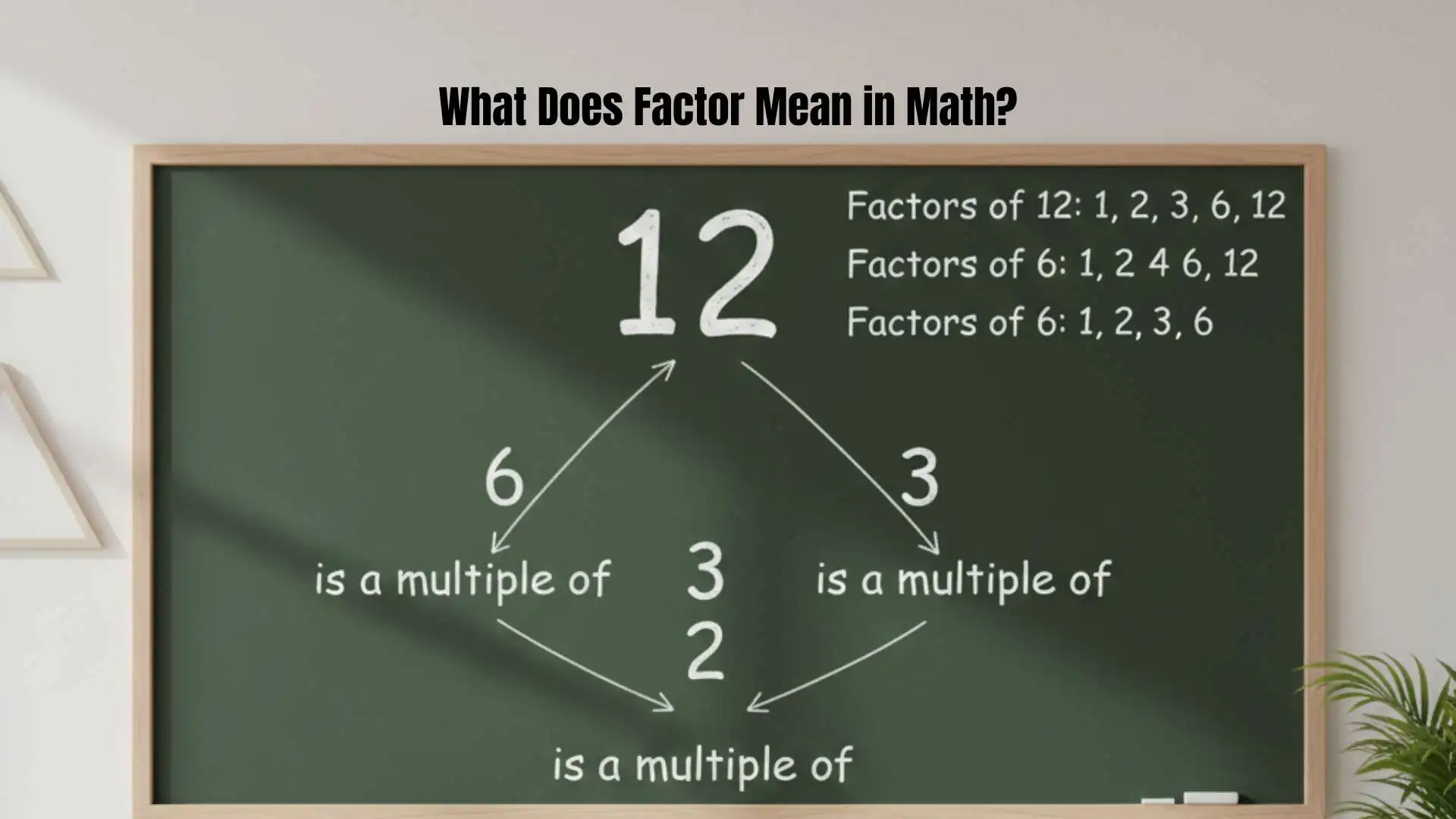
A factor in math is a number that divides another number evenly.
For example:
- 2 is a factor of 10 because 10 ÷ 2 = 5 (no remainder).
- 5 is also a factor of 10 because 10 ÷ 5 = 2.
Factors help break down numbers, simplify equations, and make multiplication easier to understand.
Example sentence:
“12 has many factors, including 3 and 4, because 3 × 4 = 12.”
In short: Factor = a number that divides another number exactly = a building block of multiplication.
Where Is “Factor” Commonly Used?
You’ll see the word factor everywhere in math, especially in:
- 📘 Basic arithmetic
- ✖️ Multiplication
- ➗ Division
- 📐 Algebra
- 🔢 Prime factorization
- 🧮 Simplifying fractions
- 📝 Math homework, tests, and word problems
Tone: It’s completely formal, academic, and used only in math — not in casual texting or social media.
Examples of “Factor” in Conversation
These aren’t texting slang examples but realistic math-related conversations showing how students, parents, or teachers use the term.
A: I don’t get this question. What are the factors of 24?
B: Just list all numbers that divide it evenly: 1, 2, 3, 4, 6, 8, 12, 24.
A: Why isn’t 5 a factor of 14?
B: Because 14 ÷ 5 doesn’t come out exact.
A: How do you know if a number is a prime?
B: It only has two factors: 1 and itself.
A: My teacher said to factor the expression. What does that mean?
B: Break it into simpler parts that multiply together.
A: Are 2 and 9 factors of 18?
B: Yep, 2 × 9 = 18.
When to Use and When Not to Use “Factor”
✅ When to Use
Use the word factor when:
- You’re talking about math.
- You’re dividing numbers.
- You’re solving multiplication problems.
- You’re finding prime factors.
- You’re simplifying fractions.
- You’re doing algebra.
❌ When Not to Use
Avoid using it when:
- You’re texting casually (it’s not a slang).
- You want a friendly or social-media tone.
- You need an informal synonyms like “reason” or “part” in general conversation.
- You’re talking about personal situations (unless you’re discussing math class!).
Comparison Table
| Context | Example Phrase | Why It Works |
|---|---|---|
| Math class | “List all factors of 30.” | Clear, academic, correct usage. |
| Homework help | “What factors multiply to give 36?” | Shows how factors help solve problems. |
| Algebra | “Factor the equation by grouping.” | Refers to breaking expressions into simpler forms. |
| Everyday speech | “What’s the main factor behind your decision?” | Using the non-math meaning: reason or cause. |
Similar Words or Alternatives
| Word | Meaning | When to Use |
|---|---|---|
| Multiple | A number you get by multiplying | When working with times tables |
| Divisor | A number that divides another | When discussing division |
| Prime number | Number with only two factors | When analyzing number types |
| Composite number | Number with more than two factors | When identifying number categories |
| Product | Result of multiplying | When explaining multiplication |
FAQs About “Factor”
❓ What is the simplest definition of a factor?
A factor is a number that divides another number evenly.
❓ How do I find factors quickly?
Check which numbers divide the number with no remainder, usually starting from 1 upward.
❓ What are prime factors?
Prime factors are the prime numbers that multiply together to make the original number.
❓ Is factor used in texting or slang?
No — it’s a formal math term, not a casual texting abbreviation.
❓ What’s the difference between factor and multiple?
A factor divides a number.
A multiple is a result of multiplying a number.
❓ Why is learning factors important?
They help with division, multiplication, simplification, algebra, and problem-solving.

John Preston is a passionate American author known for his insightful storytelling and thought-provoking narratives. With a deep love for literature and a sharp eye for detail, John crafts stories that not only entertain but also inspire reflection and growth. His modern writing style, combined with relatable characters and real-life settings, has earned him a loyal readership across diverse audiences.
Dedicated to exploring human emotions, relationships, and societal challenges, John brings authenticity and depth to every page he writes. When he’s not working on his next manuscript, you can find him in his cozy office, surrounded by books, a warm cup of coffee by his side, and his laptop always within reach.
Some of his most notable works include:
The Silent Echoes
Chasing the Dawn
Beneath the City Lights
Through his writing, John Preston continues to leave a lasting impact, one story at a time.