
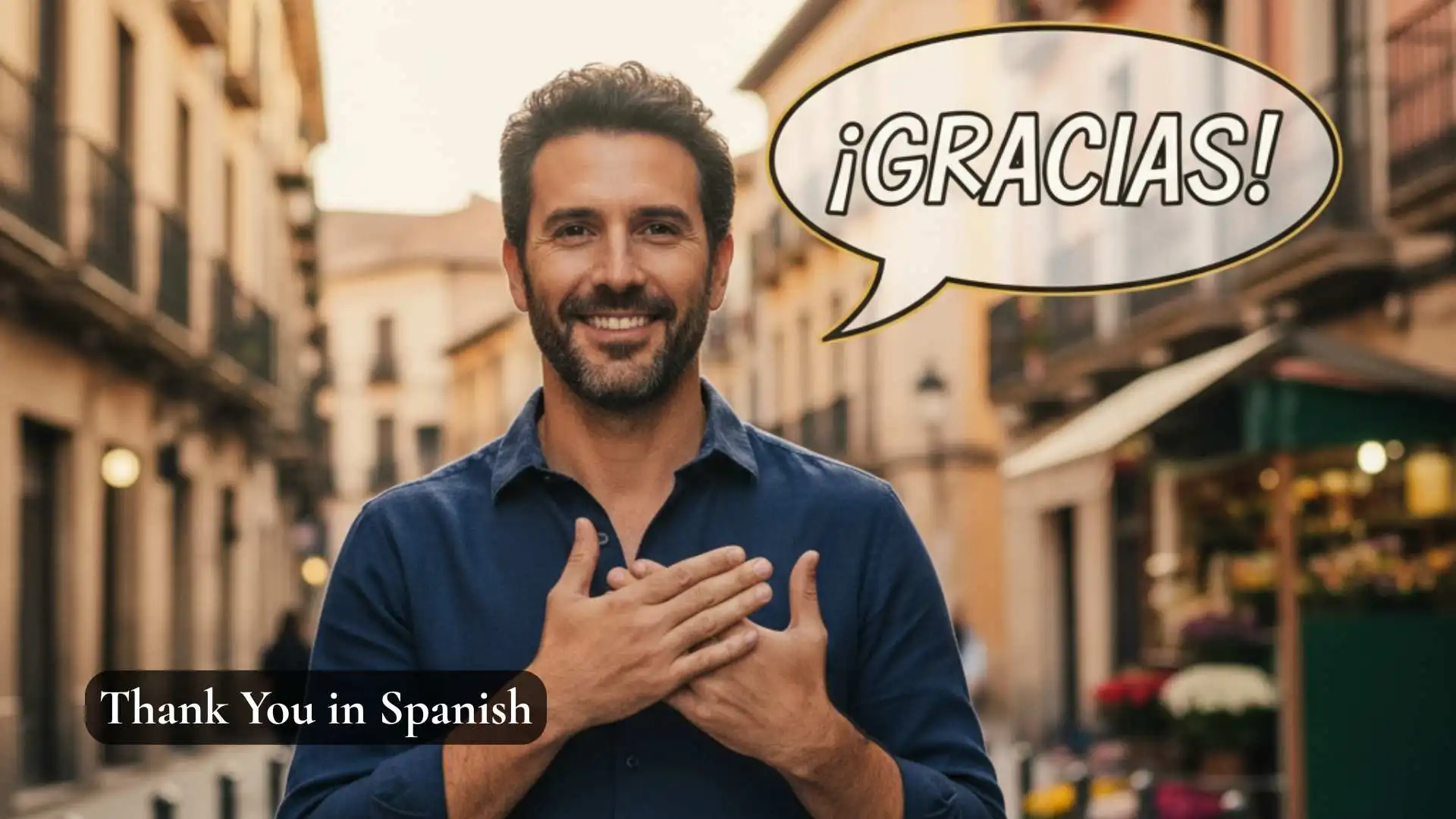
Gratitude speaks every language, but in Spanish, it carries a special warmth.
Saying “thank you in Spanish” isn’t just about words — it’s about emotion, culture, and connection.
Whether you’re thanking a friend, a waiter, or a stranger who helped you on your travels, the right phrase can make all the difference.
From simple “gracias” to heartfelt expressions like “te agradezco mucho,” Spanish offers countless ways to show appreciation.
In this guide, you’ll explore every way to say thank you naturally — and sound just like a native speaker.
Understanding “Gracias” | The Heart of Gratitude in Spanish
The word gracias is one of the first Spanish words most learners encounter—and for good reason. It’s short, powerful, and universal. But behind this tiny word lies a deep cultural value.
Etymology and Meaning
“Gracias” comes from the Latin gratia, which means grace, favor, or kindness. Over centuries, it evolved into a term that expresses appreciation and goodwill.
Pronunciation: GRAH-syahs (in Spain) or GRAH-see-ahs (in Latin America).
It’s used in every Spanish-speaking country—from Spain to Mexico, Argentina, and beyond. Still, how often and how warmly people say it can differ by culture.
“A simple gracias can open hearts in any language.”
When to Use “Gracias”
You can say “gracias” in countless situations:
- When someone hands you something.
- After receiving help or a compliment.
- In everyday politeness—like thanking a waiter or a stranger.
In Spain, it’s common to say gracias even for small gestures, while in some Latin American countries, people may use more emotional or extended versions to show deeper appreciation.
Common Ways to Say Thank You in Spanish
There’s more than one way to express thanks. Here are the core Spanish thank you phrases every learner should know.
Basic & Neutral Forms
| Spanish Phrase | English Meaning | Usage Example |
| gracias | thank you / thanks | Gracias por venir. — “Thanks for coming.” |
| muchas gracias | thank you very much | Muchas gracias por tu ayuda. |
| muchísimas gracias | thanks a lot / many thanks | ¡Muchísimas gracias por todo! |
| mil gracias | a thousand thanks | Mil gracias por tu tiempo. |
| un millón de gracias | thanks a million | Un millón de gracias, de verdad. |
These phrases work anywhere—from casual chats to formal letters. Each one adds an extra layer of warmth and sincerity.
Extended & Emotional Variations
- gracias por todo — “Thanks for everything.”
- te lo agradezco de corazón — “I thank you from the heart.”
- infinitas gracias — “Infinite thanks” (used poetically or dramatically).
💡 Tip: Adding emotion makes your words sound more genuine. Latin cultures often value heartfelt expression over minimal politeness.
Informal Ways to Say Thank You in Spanish
When you’re with friends, family, or someone close, Spanish becomes playful and expressive. Here are informal gratitude expressions used daily across Spanish-speaking countries:
| Expression | English Equivalent | Context |
| te debo una | I owe you one | Casual, friendly |
| me alegraste el día | you made my day | Emotional gratitude |
| no sé qué haría sin ti | I don’t know what I’d do without you | Deep appreciation |
| eres un amor / eres un sol | you’re so sweet / you’re amazing | Warm, informal tone |
| gracias, tío / amiga | thanks, man / thanks, friend | Regional (Spain, informal) |
These phrases make your Spanish sound natural and personal.
For example:
¡Te debo una por ayudarme con el coche! — “I owe you one for helping me with the car!”
Formal & Polite Ways to Say Thank You in Spanish
In business meetings, professional emails, or conversations with elders, tone matters. Formal Spanish relies on “usted” instead of “tú”, and polite gratitude expressions carry a respectful tone.
| Formal Phrase | English Meaning | Use Case |
| se lo agradezco | I appreciate it (formal) | To colleagues, teachers, strangers |
| estoy muy agradecido / agradecida | I’m very thankful | Expressing gratitude in writing |
| qué amable de su parte | that’s kind of you | Polite recognition |
| realmente lo aprecio | I really appreciate it | Professional or formal tone |
| le doy las gracias | I give you my thanks | Very formal, polite expression |
🕊 Note:
In Spain, formal usted is used sparingly in everyday speech. In Mexico, Colombia, and other Latin American regions, usted often signals respect rather than distance.
Alternative Expressions & Idiomatic Gratitude
Spanish thrives on idioms—colorful phrases that convey emotion. Here are some alternative gratitude expressions that sound natural to native speakers:
| Phrase | Meaning | Tone |
| me salvaste | you saved me | Casual, thankful |
| no tengo palabras | I’m speechless | Deep gratitude |
| eternamente agradecido/a | forever grateful | Emotional or formal |
| te pasaste | you went above and beyond | Friendly praise |
| gracias por nada | thanks for nothing | Sarcastic / humorous |
Tone Guide
| Tone | Example | Use Carefully? |
| Sincere | Te lo agradezco de todo corazón. | ✅ |
| Playful | Te pasaste, amigo! | ✅ |
| Sarcastic | Gracias por nada. | ⚠️ Only among friends |
How to Respond to “Thank You” in Spanish
Knowing how to respond is just as important as knowing how to thank. Here are the most natural ways to say you’re welcome in Spanish:
Standard Replies
| Response | Meaning | Typical Use |
| de nada | you’re welcome | Universal, neutral |
| no hay de qué | don’t mention it | Polite and slightly formal |
| un placer | my pleasure | Friendly, formal, or service context |
| gracias a ti / a usted | thank you too | Reciprocal response |
Natural Conversational Replies
- cuando quieras — “anytime.”
- para eso estamos — “that’s what we’re here for.”
- con gusto — “with pleasure.” (common in Mexico and Colombia).
🪄 Cultural Insight:
In Spain, de nada is the standard go-to. In Latin America, con gusto or no hay de qué sounds warmer and more polite.
Related Verbs, Word Families & Grammar Notes
To truly master Spanish expressions of gratitude, it helps to understand related verbs and their word families.
| Verb | Meaning | Example Sentence |
| agradecer | to thank / to appreciate | Te agradezco tu apoyo. |
| apreciar | to appreciate / to value | Aprecio mucho tu paciencia. |
| dar las gracias | to give thanks | Queremos darte las gracias por venir. |
| mostrar agradecimiento | to show appreciation | Mostró su agradecimiento con una sonrisa. |
Adjectives & Nouns
- agradecido/a — thankful
- agradecimiento — appreciation
💡 Grammar Note:
Use gender agreement:
- Masculine: Estoy agradecido.
- Feminine: Estoy agradecida.
Cultural Insights | Gratitude Across Spanish Speaking Countries
Spanish isn’t a single monolithic language; it’s a spectrum of cultures. Gratitude, too, varies beautifully from region to region.
| Country | Common Expressions | Cultural Note |
| Spain | Gracias, hombre / mujer, Muchas gracias tío | Friendly and direct |
| Mexico | Mil gracias, Con gusto | Warm and courteous |
| Argentina | Che, gracias loco | Casual and expressive |
| Colombia | Muy amable, Con gusto | Polite and service-oriented |
| Chile | Gracias totales (popularized by Soda Stereo) | Pop-culture influenced |
In Latin America, expressing emotion openly is common and appreciated. In Spain, people may sound more restrained, though equally sincere.
“Gratitude in Spanish isn’t just about words—it’s about tone, warmth, and connection.”
Pragmatic & Emotional Dimensions of Saying Thank You
Every “thank you” carries a message beyond the literal. Spanish gratitude involves emotion, context, and social awareness.
Emotional Tone
Spanish speakers often use tone, facial expression, and gestures to reinforce sincerity. A soft voice and a smile can say more than words.
Register Variation
- Formal: Le agradezco su tiempo.
- Informal: Gracias, amigo.
- Neutral: Muchas gracias.
Pragmatic Cues
- Use usted to show respect in formal situations.
- Use tú with friends or peers.
- Context changes everything—gracias can sound routine or heartfelt depending on delivery.
Learning Tips & Practice Tools
Learning to say thank you in Spanish isn’t just memorizing phrases—it’s about sounding natural and confident.
Practical Tips
- Listen to natives: Watch Spanish shows or YouTube vloggers to hear gratitude in context.
- Mimic pronunciation: Record yourself saying gracias, muchas gracias, de nada.
- Use gratitude daily: Thank your Spanish tutor, barista, or friends in Spanish.
Language Learning Tools
- Duolingo: great for daily vocabulary practice.
- Clozemaster: focuses on real sentences and context learning.
- Babbel and Busuu: structured lessons for conversational Spanish.
Sample Practice Dialogue
At a café in Madrid:
Customer: Un café con leche, por favor.
Barista: Aquí tienes.
Customer: ¡Muchas gracias!
Barista: De nada, ¡que tengas un buen día!
Try shadowing this conversation aloud—it builds rhythm and confidence.
SEO Keyword Integration Table
| Keyword | Intent | Placement |
| thank you in Spanish | main keyword | Title, intro, conclusion |
| how to say thank you in Spanish | informational | Headings, paragraphs |
| Spanish gratitude expressions | semantic keyword | Throughout body |
| you’re welcome in Spanish | related topic | Section 6 |
| formal ways to say thank you in Spanish | long-tail keyword | Section 4 |
| informal Spanish thank you phrases | long-tail keyword | Section 3 |
| gracias meaning | semantic depth | Section 1 |
| dar las gracias | lexical term | Grammar & verb sections |
This ensures natural, non-stuffed optimization for both Google and human readers.
FAQs
Q: What’s the difference between “gracias” and “muchas gracias”?
A: Gracias means “thank you,” while muchas gracias adds intensity—like saying “thanks a lot.”
Q: How do you say “thanks a lot” in Spanish?
A: You can say muchísimas gracias or mil gracias.
Q: What’s the most polite way to say thank you?
A: Se lo agradezco mucho or le doy las gracias are formal and polite.
Q: How do you respond to “gracias”?
A: The standard is de nada, but you can also say no hay de qué or con gusto.
Q: Is “gracias por nada” rude?
A: Yes, it’s sarcastic—used jokingly or to express frustration.
Conclusion
Saying thank you in Spanish opens more than just doors—it opens hearts. From the universal gracias to heartfelt lines like te lo agradezco de todo corazón, every phrase carries emotion and connection.
Use what you’ve learned here to show appreciation authentically. Practice daily, notice regional differences, and embrace the warmth behind Spanish culture.
“A sincere gracias doesn’t just translate—it transcends.”
So next time someone lends you a hand, say it with heart:
¡Muchísimas gracias!

John Preston is a passionate American author known for his insightful storytelling and thought-provoking narratives. With a deep love for literature and a sharp eye for detail, John crafts stories that not only entertain but also inspire reflection and growth. His modern writing style, combined with relatable characters and real-life settings, has earned him a loyal readership across diverse audiences.
Dedicated to exploring human emotions, relationships, and societal challenges, John brings authenticity and depth to every page he writes. When he’s not working on his next manuscript, you can find him in his cozy office, surrounded by books, a warm cup of coffee by his side, and his laptop always within reach.
Some of his most notable works include:
The Silent Echoes
Chasing the Dawn
Beneath the City Lights
Through his writing, John Preston continues to leave a lasting impact, one story at a time.